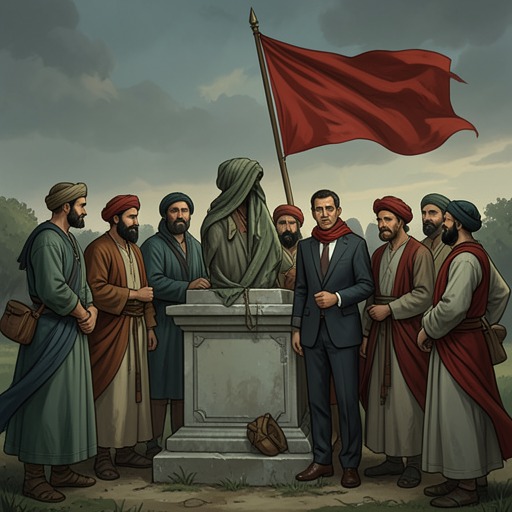
Six Jizo Guardians legend
You Only Live TwiceThe Six Jizo Guardians legend is Kuro Island’s prophecy that a man from across the sea will slay the King of Death. Told against the visible menace of Death Castle, it gives the islanders’ fear a form and an expected resolution; when James Bond destroys the castle, the prophecy becomes the community’s explanation of his arrival and its aftermath.
Island Belief and the King of Death
The legend belongs to a community already inclined to treat Death Castle as more than a nearby fortress. Kissy Suzuki tells Bond that discussion of the place is almost forbidden on Kuro Island, and describes the Ama as superstitious people who believe the devil himself has come to live across the water. The castle’s presence makes evil seem immediate: not a remote religious abstraction, but a threat occupying a particular place within sight of home.
The islanders’ elders connect that fear to a broader suspicion of Western influence, regarding the castle’s master as the embodiment of evil from the West. The local name for him, the King of Death, condenses the terror into a title. The prophecy answers that title with its own figure: a man arriving from overseas who will kill the king. In this way, the story makes the foreign setting of the threat and the foreign origin of its destined opponent part of the same structure.
Kissy cannot identify a definite author or origin for the prophecy. She wonders whether it came from the sea or the air and entered the minds of the people, then stresses that it is widely believed. The tale is presented as communal knowledge rather than a documented prediction with a known teller. Its authority comes from being shared across the island, not from an explanation of how it began.
The Six Guardians and Island Life
The Six Jizo Guardians are stone figures on the shore, associated by Kissy with Jizo, whom she identifies as a Buddhist protector of children. Five statues remain recognizably intact; the sixth has been mostly washed away. They squat in a line at the low-tide mark, with rough stone bodies, rounded heads, and white shirts that islanders replace each month. As the tide rises, it covers them, and the community imagines them keeping watch beneath the water.
Their protective role is specific to the Ama, whom Kissy calls the Children of the Sea. The statues stand at the boundary between shore and sea, the environment on which the divers depend and in which they work. The island’s annual observance makes that connection public: at the beginning of June, when the water has warmed after winter and diving begins, the people form a procession to the figures and sing to make them favourable. The guardians are thus not only characters in a prophecy but part of a recurring practice tied to the community’s livelihood and calendar.
Kissy also invokes their protection when Bond worries that sharks may threaten him in the water. She says sharks do not trouble the Ama and recalls an old accident in which a diver’s rope caught on an underwater rock, an event the people continued to discuss. Her account places practical danger and inherited belief side by side: the story of the guardians provides reassurance about the sea, while the remembered accident records that its hazards are real.
The Prophecy and Bond’s Arrival
The legend becomes personally relevant when Kissy tells Bond that the guardians’ prophecy calls for a man from across the sea to slay the King of Death. Bond asks where the story came from, but receives no firmer answer than its wide acceptance. Their exchange ends lightly, and the pair return to their work; at this point, the prophecy is a local belief, not a task Bond has consciously undertaken.
Later, Bond visits the statues with Kissy. At close range, their rounded stone heads and rough bodies seem almost human, while their fixed posture gives them an air of judgment over the waters. Bond feels awe at the belief and authority invested in them. He briefly wants to kneel and seek their blessing, then instead bows his head and asks for good fortune to accompany his enterprise. His response marks a shift from amused inquiry toward a moment of respect, without establishing that he accepts the legend as literally true.
Kissy makes a more openly personal appeal to the figures, clapping to attract their attention and speaking passionately while Bond’s name recurs. Afterward, she asks whether Bond saw the heads nod. He firmly denies seeing any movement. The scene preserves two readings: for Kissy, the guardians appear to affirm their protection; for Bond, no physical sign confirms that interpretation. The story’s force rests less on proof of supernatural action than on the meaning the islanders give to the statues and to Bond’s presence among them.
Fulfillment and Aftermath
After Bond destroys Death Castle, the island’s Shinto priest tells Kissy that the spawn of the devil and his wife are dead, the castle has been totally destroyed, and the events have occurred as the Six Guardians foretold, through the man from across the sea. The prophecy now supplies a narrative of fulfillment: the feared ruler and his wife are gone, and the outsider named by the legend has brought about their destruction. The priest’s account confirms the island’s interpretation of events; it does not show the guardians intervening directly.
Kissy uses that interpretation to argue that Kuro Island should cherish and honour Bond as a hero brought by the gods. She asks the priest to let her care for him, explaining that Bond remembers nothing of his past and that she wants him to remain with her. She also proposes that the elders use shiran-kao, pretending to know nothing, so that outsiders searching for him will believe he has left for the mainland. The priest agrees to help, while warning that Bond must remain concealed until the situation is quiet.
The legend therefore continues to matter after the castle falls. It makes Bond’s rescue of Kuro more than a military or personal victory in the eyes of the islanders: it turns him into the prophesied man and gives Kissy a sacred argument for protecting him. Bond’s amnesia and concealment then complicate the prophecy’s apparent ending. The danger named by the legend has been destroyed, but the man it identifies is still on Kuro, where communal belief helps shape what happens to him next.